Supervisor-Worker Orchestration: Designing Hierarchical Multi-Agent Systems
In multi-agent architectures, organizing communication flows is a primary design challenge. If every agent is allowed to talk to every other agent, communication overhead scales quadratically:
O(N^2)
leading to confusion, lost context, and infinite loops.
The Supervisor-Worker Orchestration pattern addresses this by introducing a hierarchical structure. A central Supervisor agent manages task assignment, monitors progress, and synthesizes the final result, while specialized Worker agents execute specific tasks.
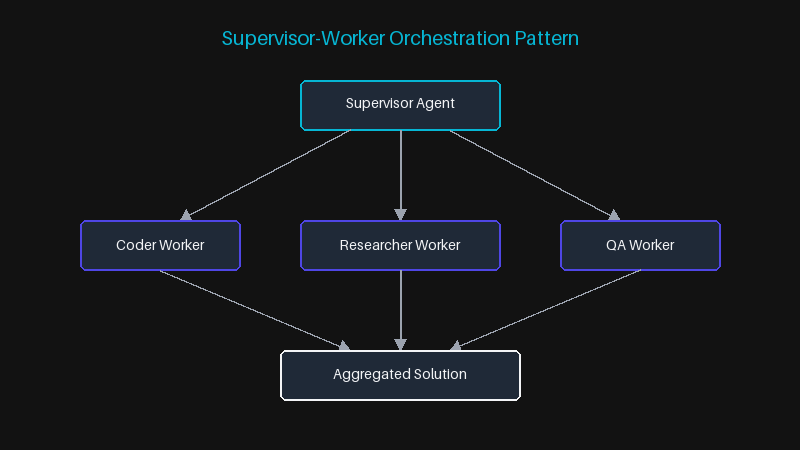 Supervisor-Worker Orchestration Pattern
Core Components of the Pattern
- Supervisor: An LLM agent that acts as a project manager. It receives the user query, breaks it down into subtasks, assigns them to workers, reviews results, and decides whether the task is complete.
- Workers: Independent, specialized agents or tools (e.g., Code Executor, SQL Reader, Document Searcher). They execute only the task assigned by the Supervisor and return their results.
Implementing a Supervisor-Worker System in Python
Here is a mock implementation showing how a supervisor agent manages and routes tasks:
import json
import openai

def coder_worker(task):
    return f"[Coder Result] Successfully wrote python code to solve: {task}"

def researcher_worker(task):
    return f"[Researcher Result] Found relevant information for: {task}"

def run_supervisor(user_request):
    client = openai.OpenAI()

    # Define instructions
    system_prompt = (
        "You are a Supervisor Agent. You break user requests into subtasks "
        "and assign them to 'coder' or 'researcher' by responding with JSON: "
        '{"worker": "coder" | "researcher" | "complete", "task": "details"}'
    )

    messages = [
        {"role": "system", "content": system_prompt},
        {"role": "user", "content": user_request}
    ]

    # Supervisor runs the delegation loop
    # response = client.chat.completions.create(model="gpt-4o-mini", messages=messages)
Advantages of the Hierarchical Model
- Reduced Noise: Workers only see the specific instructions needed for their task, preventing them from being overwhelmed by the broader system state.
- Modularity: You can swap or update individual workers without modifying the rest of the architecture.
- Dynamic Adaptability: The supervisor can dynamically adjust execution paths based on intermediate worker outputs.
Conclusion
The Supervisor-Worker Orchestration pattern is a reliable architecture for complex, multi-step tasks. Providing a single orchestrator to manage delegation and evaluation ensures structured, clean communication and higher execution quality.