PII Redaction: Automating Data Anonymization in Generative AI Pipelines
 By Bishwambhar Sen
Integrating Generative AI into customer service, legal document analysis, and enterprise search platforms requires handling sensitive user data. A key risk is the exposure of Personally Identifiable Information (PII)—such as names, addresses, credit cards, and social security numbers—to LLM APIs or search databases.
Exposing PII can violate compliance regulations (like GDPR and HIPAA) and lead to data leaks.
To secure user privacy, applications should implement automatic PII redaction and data anonymization layers before storing or sending text.
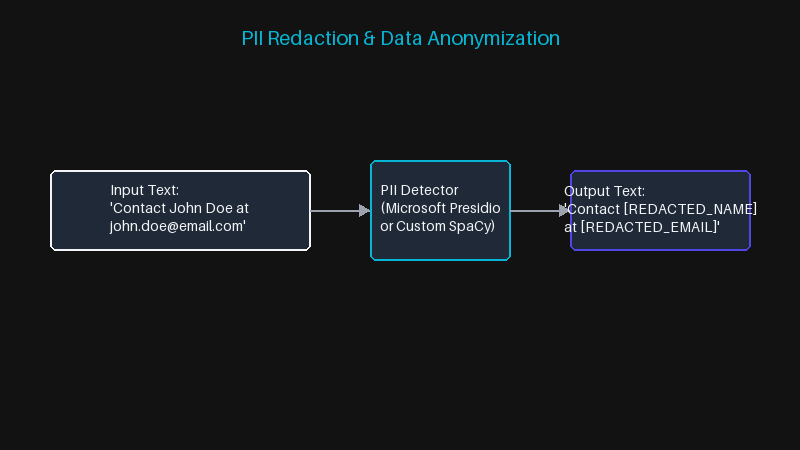 PII Redaction & Data Anonymization
The Redaction Pipeline
A standard PII redaction pipeline involves:
- Detection: Analyzing text to locate PII tokens using regular expressions, Named Entity Recognition (NER), and pattern matching.
- Anonymization: Replacing identified PII tokens with generic placeholders (e.g., replacing "John Smith" with
[REDACTED_NAME]) or generating synthetic equivalents. - Deanonymization (Optional): Storing the original values in a secure, encrypted mapping table so that once the LLM returns its response, the original names can be restored.
Mathematically, a redaction function R(T) maps a text string T to an anonymized version:
R(T): T \rightarrow T' \quad \text{where } \forall x \in \text{PII}, x \notin T'
Python Implementation using Microsoft Presidio
Microsoft Presidio is an open-source library for PII detection and anonymization. Here is an implementation:
from presidio_analyzer import AnalyzerEngine
from presidio_anonymizer import AnonymizerEngine
from presidio_anonymizer.entities import OperatorConfig

# 1. Initialize engines (AnalyzerEngine loads a spaCy NER model on first use)
analyzer = AnalyzerEngine()
anonymizer = AnonymizerEngine()

# Sample text containing PII
text_content = (
    "Hi, my name is John Doe. My email is john.doe@example.com "
    "and you can reach me at 555-123-4567."
)

# 2. Analyze the text for PII entities
results = analyzer.analyze(
    text=text_content,
    entities=["PERSON", "EMAIL_ADDRESS", "PHONE_NUMBER"],
    language="en",
)

for entity in results:
    print(f"{entity.entity_type:15} score={entity.score:.2f} "
          f"text={text_content[entity.start:entity.end]!r}")

# 3. Anonymize the text with per-entity replacement rules
anonymized_result = anonymizer.anonymize(
    text=text_content,
    analyzer_results=results,
    operators={
        "PERSON": OperatorConfig("replace", {"new_value": "[REDACTED_NAME]"}),
        "EMAIL_ADDRESS": OperatorConfig("replace", {"new_value": "[REDACTED_EMAIL]"}),
        "PHONE_NUMBER": OperatorConfig("mask", {
            "masking_char": "*",
            "chars_to_mask": 8,
            "from_end": True,
        }),
    },
)

print("\nAnonymized:", anonymized_result.text)
# Anonymized: Hi, my name is [REDACTED_NAME]. My email is [REDACTED_EMAIL]
# and you can reach me at 555-********.
Advanced Anonymization: Pseudonymization
Simple redaction can sometimes degrade LLM performance because the model loses context (e.g., distinguishing between different redacted individuals). To address this, use pseudonymization:
- Instead of replacing all names with
[NAME], replace them with consistent pseudonyms: "John Doe" becomes[PERSON_1], "Jane Smith" becomes[PERSON_2]. - This preserves the relationships and logical structure within the text, allowing the LLM to process it accurately.
Conclusion
Be careful how you describe this layer internally, because the phrase "we redact PII" tends to get heard as "we have solved compliance." Automated detection is statistical. Presidio's NER will miss an unusual surname, a name embedded in an email signature block, or an address written in a format its recognizers were not trained on — and the misses are exactly the cases you never see, because nothing alerts when a name slips through. Treat redaction as risk reduction, not as a guarantee, and be honest about that distinction with whoever signs off on your data handling.
The failure mode people underestimate is over-redaction. Tune your confidence threshold too low and the analyzer starts flagging ordinary nouns as PERSON — medical text is notorious for this, where drug and procedure names get eaten — and the model receives a sentence full of placeholders that no longer means anything. You will see this as unexplained quality degradation rather than as a redaction bug, so log a sample of redacted text and read it periodically. If your pipeline supports deanonymization, remember that the mapping table you keep in order to restore names is itself a concentrated store of exactly the data you were trying to protect. It needs encryption at rest, a short retention window, and tighter access control than the pipeline around it.
For anything genuinely high-stakes, the more defensible architecture is not better redaction — it is not sending the data out at all. A self-hosted model keeps text inside your trust boundary, which removes the entire class of problem rather than filtering it. Redaction is the right answer when you have accepted a third-party API and need to reduce exposure; it is the wrong answer when the real requirement was never to transmit the data in the first place.