Advanced RAG: Implementing Parent Document Retrieval for Richer Context
 By Bishwambhar Sen
Retrieval-Augmented Generation (RAG) has emerged as the standard architecture for ground truth grounding in Large Language Model (LLM) applications. However, standard RAG pipelines suffer from a fundamental tension: the retrieval chunk size tradeoff.
If you embed and store small chunks (e.g., 100-200 tokens), the vector search is highly precise, identifying specific facts easily. However, when these small chunks are fed directly to the LLM, they often lack the surrounding context needed to synthesize a coherent or accurate answer. Conversely, if you embed and store large chunks (e.g., 1000-2000 tokens), the vector embeddings represent a broader mix of topics, which dilutes the semantic signal and results in lower retrieval precision.
Parent Document Retrieval resolves this tension by decoupling the chunks used for vector search from the chunks used for LLM generation.
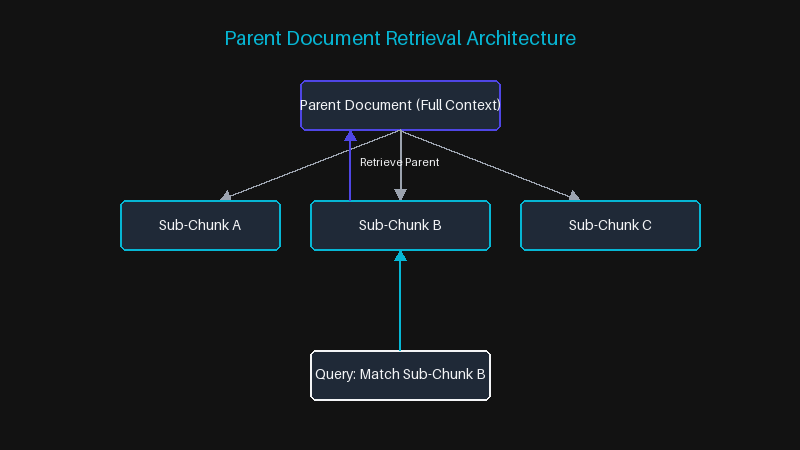 Parent Document Retrieval Architecture
The Mechanics of Parent Document Retrieval
The core idea is simple:
- Divide large documents (called "Parent Documents") into smaller, overlapping segments (called "Child Documents").
- Embed and index only the Child Documents in your vector database.
- Keep a mapping in a key-value store (e.g., Redis or an in-memory dictionary) linking each Child Document ID to its corresponding Parent Document.
- During query time, perform vector search against the Child Documents.
- Once the top-scoring Child Documents are retrieved, retrieve their Parent Documents from the key-value store and pass those entire Parent Documents (or a larger window around the child) to the LLM context.
Mathematically, let D represent a parent document and c_i represent the child chunks generated from D such that:
D = \bigcup_{i=1}^{n} c_i
If the query is q, we compute the cosine similarity between the query embedding E(q) and child embeddings E(c_i):
\text{sim}(q, c_i) = \frac{E(q) \cdot E(c_i)}{\|E(q)\| \|E(c_i)\|}
Instead of sending the retrieved child chunk c^* = \text{argmax}_{c_i} \text{sim}(q, c_i) directly to the prompt, we map it back to D and feed D to the LLM.
Python Implementation using LangChain
Here is a step-by-step implementation of Parent Document Retrieval using LangChain:
from langchain_community.vectorstores import Chroma
from langchain_openai import OpenAIEmbeddings
from langchain.text_splitter import RecursiveCharacterTextSplitter
from langchain.storage import InMemoryStore
from langchain.retrievers import ParentDocumentRetriever
from langchain_core.documents import Document

# 1. Initialize parent and child splitters
parent_splitter = RecursiveCharacterTextSplitter(chunk_size=2000, chunk_overlap=200)
child_splitter = RecursiveCharacterTextSplitter(chunk_size=400, chunk_overlap=50)

# 2. Setup database and store
vectorstore = Chroma(embedding_function=OpenAIEmbeddings())
store = InMemoryStore()

# 3. Initialize retriever
retriever = ParentDocumentRetriever(
    vectorstore=vectorstore,
    docstore=store,
    child_splitter=child_splitter,
    parent_splitter=parent_splitter,
)

# 4. Load dummy documents
docs = [
    Document(
        page_content="Large language models (LLMs) are deep learning models trained on massive text datasets. They can perform tasks like translation, summarization, and reasoning. Retrieval-Augmented Generation (RAG) is a technique that enhances LLMs by retrieving relevant context from external sources before generation. This reduces hallucinations.",
        metadata={"source": "llm_guide.txt"}
    )
]

# 5. Add documents to retriever
retriever.add_documents(docs, ids=None)

# 6. Retrieve relevant documents
query = "What is the primary benefit of RAG?"
retrieved_docs = retriever.invoke(query)
print("Retrieved parent document length:", len(retrieved_docs[0].page_content))
Key Considerations and Tuning Parameters
When implementing Parent Document Retrieval, several hyperparameters require careful tuning:
- Parent-to-Child Ratio: A parent chunk of 1500-2000 tokens with child chunks of 200-400 tokens is a solid starting baseline. If child chunks are too small, their embeddings may lose sentence-level semantics.
- Context Limits: If you retrieve multiple parent documents, you can easily exceed the context window or trigger the "lost in the middle" effect in the LLM. Applying a reranker (e.g., Cohere) or a context compressor before feeding to the LLM is highly recommended.
- Storage Strategy: Unlike vector databases which only house embeddings and child chunks, Parent Document Retrieval requires an external document store. In production, persistent databases like PostgreSQL (with JSONB) or Redis are preferred over in-memory key-value stores.
Conclusion
The pattern has a specific failure case that its advocates rarely mention: parent documents are much larger than child chunks, so retrieving five of them can put 10,000 tokens of mostly-irrelevant text in front of the model. That is the "lost in the middle" problem, and Parent Document Retrieval actively makes it worse than plain small-chunk retrieval. The precision you gained at the vector-search stage can be given straight back at the generation stage. If your answers get vaguer after adopting this pattern, that is why — lower k, or put a reranker between retrieval and generation.
It also assumes your documents have meaningful large-scale structure. That holds for policy manuals, research papers, and legal contracts, where a paragraph only makes sense inside its section. It does not hold for support tickets, chat logs, product listings, or FAQ entries, where each record is already self-contained. Applying parent retrieval to a corpus of short independent records adds a document store, a mapping layer, and a second lookup on every query, in exchange for nothing.
One implementation detail worth flagging because it bites people in production: the InMemoryStore in the example is not persistent. Restart the process and your vector database still holds every child embedding while the parent mapping is gone, so retrieval returns IDs that resolve to nothing. Swap it for Redis or Postgres before deploying, and make sure your reindexing job rebuilds both stores together — a vector index and a docstore that have drifted out of sync fail silently, which is the worst way for a retrieval system to fail.
If you are choosing between advanced RAG patterns and can only invest in one, a reranker usually delivers more measurable improvement per hour of work than this does. Parent retrieval is the right tool when your evaluation shows the model has the correct chunk and still answers badly for lack of surrounding context — diagnose that first rather than adopting it on principle.
Go deeper in the course
- Advanced RAG PatternsLesson 1: Chunking Strategies That Actually WorkFixed-size, recursive character, semantic, and document-aware chunking — learn how chunk size and overlap directly impact retrieval quality, with experiments to prove it.
- Advanced RAG PatternsLesson 6: Contextual Compression & FilteringFilter retrieved chunks down to only the sentences that answer the query, using LLM-based extractive compression. Reduce token costs while improving answer quality.