The Evolution of Neural Networks: From Perceptrons to Transformers
 By Bishwambhar Sen
Artificial neural networks (ANNs) have revolutionized the field of machine learning, enabling breakthroughs in computer vision, natural language processing, and robotics. But this didn't happen overnight. The journey from the earliest mathematical models of a neuron to the massive Transformer networks of today spans over seven decades of research, "AI winters," and algorithmic breakthroughs.
In this guide, we will trace the evolution of neural networks, exploring the key architectures that defined each era.
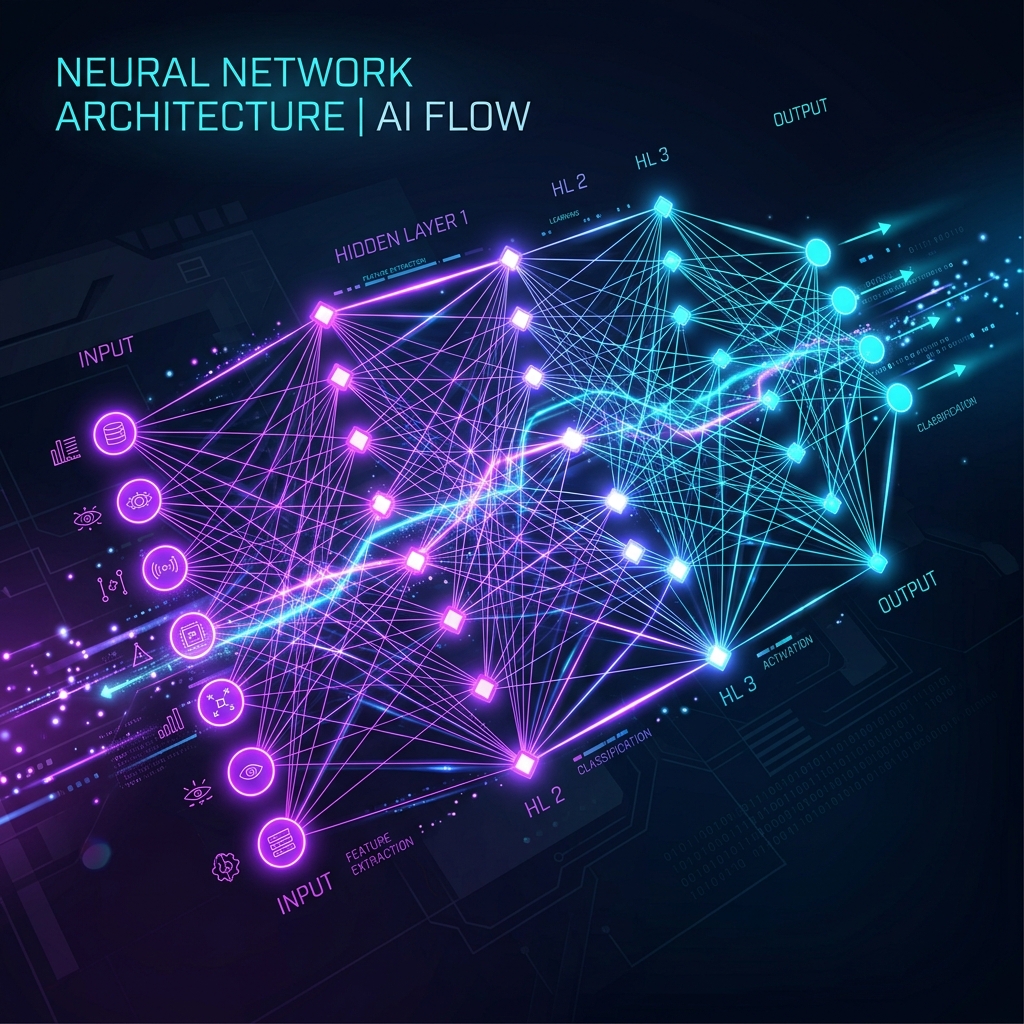 Deep Neural Network Architecture and Layer Connectivity
The Dawn of Artificial Neurons (1940s - 1960s)
The story begins in 1943 when neurophysiologist Warren McCulloch and mathematician Walter Pitts created the first mathematical model of a biological neuron. Their model was a simple logic gate that fired an output if the sum of its inputs crossed a specific threshold.
However, it was Frank Rosenblatt in 1958 who brought the concept to life with the Perceptron. The Perceptron was an algorithm (initially implemented as custom hardware) designed for image recognition. It introduced the concept of "weights"—values that could be adjusted to "learn" from data.
While the Perceptron generated immense excitement, it had a fatal flaw. In 1969, Marvin Minsky and Seymour Papert proved that a single-layer perceptron could not learn non-linear functions, such as the simple XOR logic gate. This mathematical limitation led to a sudden drop in funding and research, ushering in the first "AI Winter."
The Backpropagation Renaissance (1980s)
To solve the XOR problem, researchers needed to stack perceptrons into multiple layers (Multi-Layer Perceptrons or MLPs). But there was no known algorithm to efficiently update the weights in the "hidden" middle layers.
This changed in 1986 when Geoffrey Hinton, David Rumelhart, and Ronald Williams popularized Backpropagation. Backpropagation is an algorithm that uses the chain rule of calculus to calculate how much each weight contributed to the final error, allowing the network to update its weights in the correct direction.
This breakthrough allowed researchers to train multi-layer neural networks, solving complex, non-linear problems and reviving interest in the field.
Computer Vision and CNNs (1990s - 2010s)
While MLPs were powerful, they struggled with high-dimensional data like images. If you feed a 100x100 pixel image into a standard dense network, the sheer number of connections causes an explosion in parameters, leading to slow training and severe overfitting.
Inspired by the biological visual cortex, Yann LeCun introduced the Convolutional Neural Network (CNN) in 1989. Instead of connecting every input to every neuron, CNNs use "filters" that slide over the image, detecting local patterns like edges and textures regardless of where they appear.
The true tipping point for CNNs came in 2012 during the ImageNet competition. A deep CNN named AlexNet, trained on GPUs, utterly crushed traditional computer vision algorithms, halving the error rate. This moment is widely considered the start of the modern Deep Learning boom.
Handling Sequence: RNNs and LSTMs
While CNNs conquered spatial data (images), they could not handle sequential data like text or time-series, where the order of inputs matters.
Recurrent Neural Networks (RNNs) were designed to solve this by maintaining a hidden "state" or memory that is passed from one step to the next. However, standard RNNs suffered from the "vanishing gradient problem," making it impossible for them to remember information over long sequences.
In 1997, Sepp Hochreiter and Jürgen Schmidhuber introduced the Long Short-Term Memory (LSTM) network. LSTMs added complex gating mechanisms that learned what information to keep, what to forget, and what to output, successfully bridging the gap for long-sequence tasks like language translation and speech recognition.
The Transformer Revolution (2017 - Present)
LSTMs were the kings of NLP for a decade, but they had a critical bottleneck: they had to process data sequentially. You couldn't process the 10th word of a sentence until you had processed the first 9. This made them difficult to parallelize on modern GPUs.
In 2017, researchers at Google published the seminal paper Attention Is All You Need, introducing the Transformer architecture.
Transformers discarded recurrence entirely. Instead, they relied purely on the Self-Attention mechanism. Self-attention allows the network to look at the entire sequence of words at once and determine how much "attention" each word should pay to every other word to understand the context. For example, in the sentence "The bank of the river," attention helps the model realize "bank" relates to "river" rather than finance.
Because Transformers process all inputs simultaneously, they are highly parallelizable, allowing researchers to train exponentially larger models on massive datasets. This architecture forms the backbone of modern Large Language Models (LLMs) like GPT-4, Claude, and Gemini, defining the current era of Generative AI.
What's Next?
Told this way, the history reads as a clean staircase: each architecture solves the previous one's flaw and retires it. That framing is tidy and somewhat misleading, and it is worth correcting before you carry it into practice.
None of these architectures actually died. Convolutional networks remain the default for most real image work — they are smaller, faster, and need far less data than a Vision Transformer, which only overtakes CNNs at dataset sizes most teams will never have. Logistic regression, a direct descendant of the perceptron, still runs an enormous amount of production classification because it trains in seconds and you can explain its coefficients to a regulator. Recurrent models are back under new names, because the Transformer's self-attention costs memory quadratic in sequence length, which is the exact weakness that made recurrence attractive in the first place. Mamba and the state space family are not a break from history so much as a return to it with better hardware awareness.
The other thing the staircase obscures is that the ideas usually arrived long before they worked. Backpropagation was described years before 1986. LeCun's convolutional networks read cheques commercially in the 1990s and then went quiet for fifteen years. What changed in 2012 was not the algorithm but that GPUs and ImageNet arrived at the same time. The lesson to carry forward is a slightly deflating one: the field's step changes have come more often from compute and data than from architectural insight, which suggests some caution about assuming the next one will announce itself as a clever new paper.
The practical takeaway for anyone building today is to resist reaching for the most recent architecture by default. Match the model to the size of your dataset and the shape of your problem. A great many production systems would be better, cheaper, and easier to debug if they used a technique from the 1990s.
Go deeper in the course
- Neural Networks & Deep LearningLesson 1: Activation Functions & BackpropagationUnderstand how neural networks learn by calculating gradients and updating weights.
- Generative AI & LLMsLesson 1: How Transformers and Attention WorkDemystify the architecture that powers modern LLMs like GPT-4 and Claude.