Scaling AI: An Introduction to MLOps and Production Pipelines
 By Bishwambhar Sen
Training a machine learning model on a local laptop or Jupyter Notebook is only the first step. Moving that model to a production environment where it can serve predictions to millions of users reliably, securely, and at scale introduces a new set of challenges.
This is where MLOps (Machine Learning Operations) comes in. MLOps adapts DevOps practices to the unique lifecycle of machine learning. In this guide, we will analyze the key pillars of MLOps, explain the mechanics of model registries, and walk through a Python simulation of an automated model promotion pipeline.
The Three Pillars of MLOps
While traditional software engineering focuses primarily on code versioning and application state, machine learning is governed by three separate vectors: Code, Data, and Models.
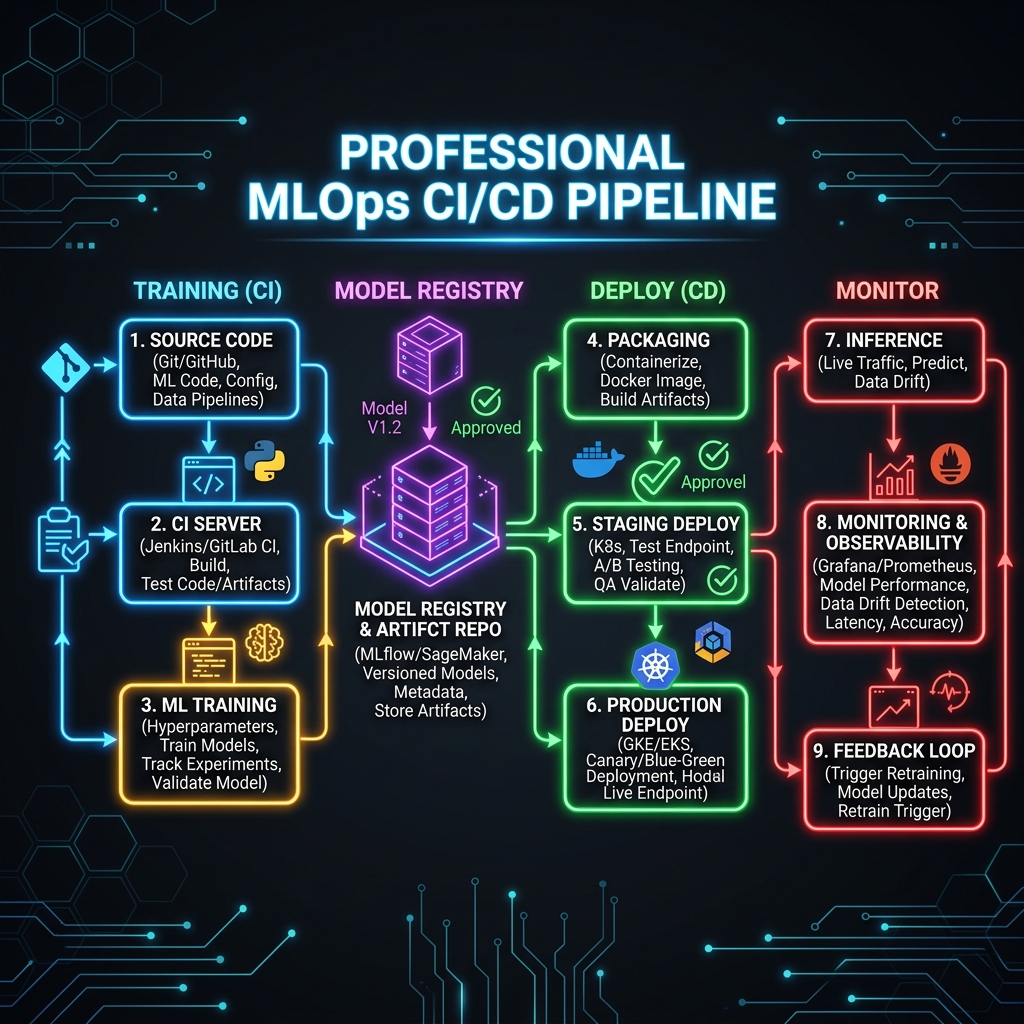 MLOps Production Pipeline: Professional MLOps pipeline showing Code, Data, and Model Versioning
- Code Versioning (Git): Standard version control for training scripts, preprocessing code, and deployment APIs.
- Data Versioning (DVC): Tracking the exact datasets used to train specific model runs. Because models are functions of their training data, tracking data is critical for reproducibility.
- Model Versioning (Registries): Managing model weights, metadata, parameters, and training metrics in a centralized storage system.
1. The Model Registry
A Model Registry (such as MLflow or Weights & Biases) is a centralized repository that acts as a catalog for your trained models. It manages:
- Model Signatures: Defining input and output schemas (e.g., inputs must be 4 floats, outputs must be 1 float).
- Versioning: Storing version numbers (e.g.,
v1,v2) so teams can roll back if a new model fails in production. - Stage Transitions: Categorizing models into operational stages like
Development,Staging,Production, orArchived.
2. CI/CD for Machine Learning
In standard DevOps, Continuous Integration (CI) checks for syntax issues and compiles code, while Continuous Deployment (CD) pushes the built container to production. In MLOps:
- Continuous Integration (CI): Runs automated tests to ensure training scripts run without errors, verifies that model architecture compiles, and validates data formats.
- Continuous Training (CT): Automated pipelines that retrain models when new data becomes available.
- Continuous Deployment (CD): Automatically deploys the newly trained model to a staging environment, runs validation checks, and routes API traffic to the model if it passes performance benchmarks.
3. Detecting Drift: Why Production Models Fail
Once a model is deployed, its performance will inevitably degrade over time due to drift:
- Data Drift: The statistical distribution of the input data shifts. For example, if a model trained on housing prices from 2020 faces inflation in 2026, the input prices will shift, leading to skewed predictions.
- Concept Drift: The relationship between the input features and target variables changes. For example, consumer behavior shifts during a sudden economic event, meaning pre-event models no longer map features to targets correctly.
To catch drift, MLOps engineers set up real-time monitoring pipelines that compare incoming production data against the original training distribution using statistical tests like the Kolmogorov-Smirnov test.
4. Implementing Model Promotion Logic in Python
Below is a Python demonstration of a Model Validator. In a production CD pipeline, this code runs automatically after a new model is trained, verifying that the new candidate outperforms the current production model before promoting it.
import numpy as np

class ModelPromotionPipeline:
    def __init__(self, accuracy_threshold=0.85):
        self.threshold = accuracy_threshold
        self.registry = {
            "production": {"id": "model_v1", "accuracy": 0.88},
            "candidate": {"id": "model_v2", "accuracy": 0.91}
        }

    def validate_candidate(self, test_features, test_labels):
        """Simulates running validation checks on the candidate model."""
        print(f"Validating Candidate Model: {self.registry['candidate']['id']}")

        # Retrieve candidate accuracy
        candidate_accuracy = self.registry["candidate"]["accuracy"]
        prod_accuracy = self.registry["production"]["accuracy"]

        print(f"Production Accuracy: {prod_accuracy:.2f}")
        print(f"Candidate Accuracy:  {candidate_accuracy:.2f}")

        # Check 1: Meet the baseline quality threshold
        if candidate_accuracy < self.threshold:
            print("❌ Validation Failed: Candidate does not meet the minimum threshold.")
            return False

        # Check 2: Outperform current production model
        if candidate_accuracy <= prod_accuracy:
            print("❌ Validation Failed: Candidate does not outperform production model.")
            return False

        print("✅ Validation Successful! Candidate model satisfies all criteria.")
        return True

    def promote_to_production(self):
        """Promotes candidate to production stage in registry."""
        candidate = self.registry["candidate"]
        old_prod = self.registry["production"]

        # Transition stages
        self.registry["production"] = candidate
        self.registry["archived"] = old_prod
        del self.registry["candidate"]

        print(f"\n--- Registry Updated ---")
        print(f"Active Production Model: {self.registry['production']['id']}")
        print(f"Archived Model:          {self.registry['archived']['id']}")

# Initialize pipeline
pipeline = ModelPromotionPipeline(accuracy_threshold=0.85)

# Run validation checks
dummy_features, dummy_labels = np.random.rand(100, 5), np.random.randint(0, 2, 100)
if pipeline.validate_candidate(dummy_features, dummy_labels):
    pipeline.promote_to_production()
Summary
The promotion gate in the script above encodes a rule that is wrong more often than it looks: promote if aggregate accuracy improves. In practice a candidate can gain a point of overall accuracy while getting materially worse on the subgroup that matters most — the fraud cases, the rare disease class, the enterprise-tier customers. Aggregate metrics average that damage away. Any promotion check worth having should evaluate per-segment and block a promotion that regresses a protected slice, even when the headline number is up.
Two other things are worth pushing back on. First, automated retraining is oversold. Continuous training on a schedule sounds disciplined, but if your labels arrive with a delay, or arrive from a system whose outputs your own model influenced, you are building a feedback loop that silently drifts toward its own predictions. Retraining triggered by a monitored drift signal is safer than retraining triggered by a calendar. Second, drift alerts based on Kolmogorov-Smirnov tests over high-volume production data will fire constantly — at large n the test detects statistically significant shifts that are practically meaningless. Pair any drift test with an effect-size threshold, or your team will learn to ignore the channel within a month.
If you are starting from nothing, the highest-value piece is not the registry or the CI pipeline. It is being able to answer, for any prediction your system made last Tuesday, which model version and which training dataset produced it. Get that lineage in place first; everything else in MLOps is easier to add later and much harder to reconstruct after an incident.
Go deeper in the course
- Production MLOps & Model DeploymentLesson 4: Build a Production PipelineCreate an automated CI/CD pipeline that packages, tests, and deploys an active ML classifier.
- Production MLOps & Model DeploymentLesson 2: Containerization with DockerPackage deep learning models, weights, and runtimes inside isolated, lightweight Docker containers.