Why Interactive Learning Beats Video Tutorials for Coding
 By Bishwambhar Sen
If you have ever tried to learn a new programming language, framework, or machine learning concept, you are likely familiar with "Tutorial Hell."
You watch a highly polished 4-hour YouTube video. You nod along as the instructor effortlessly builds a complex application. Everything makes perfect sense. But the moment you open a blank IDE to build something yourself, your mind goes entirely blank. You don't know where to start.
This phenomenon is incredibly common, and it stems from a fundamental mismatch between how our brains acquire skills and how video tutorials deliver information.
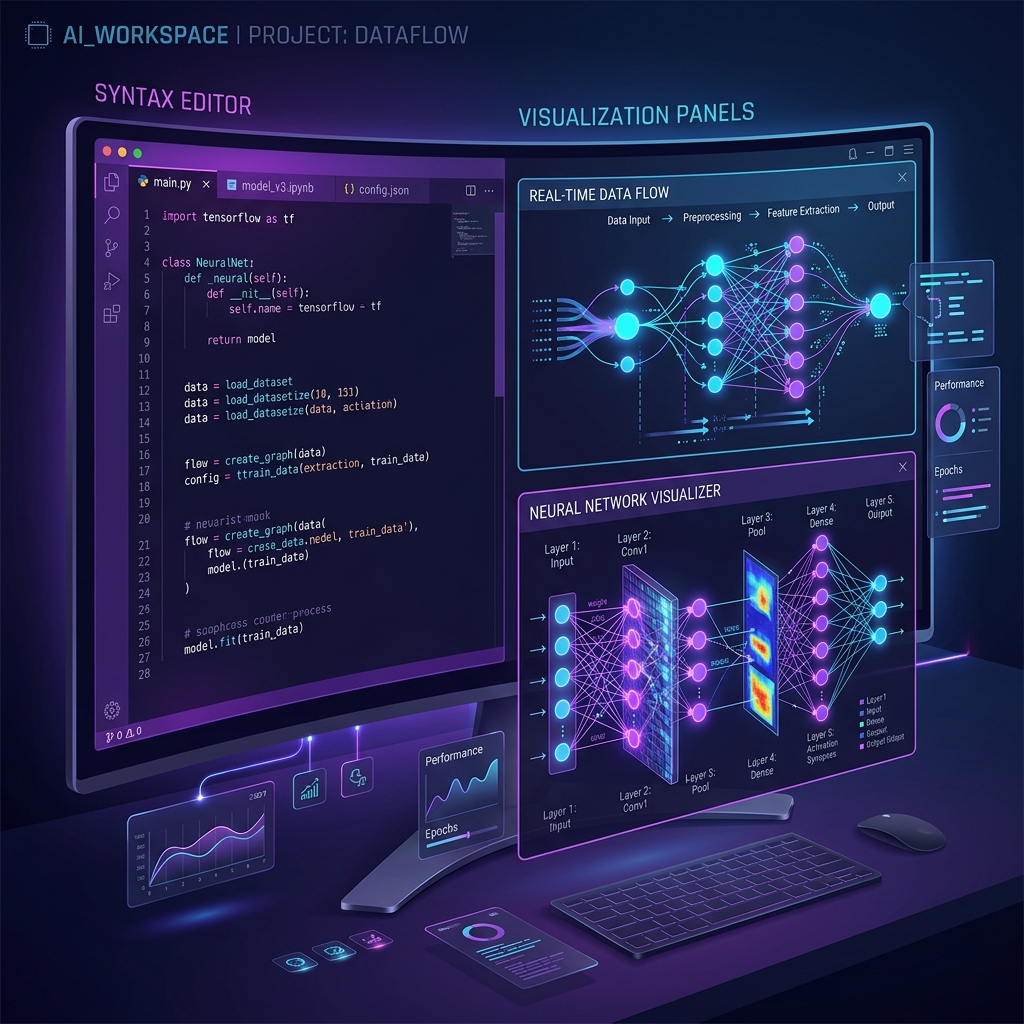 Interactive Coding Workspace and Visual Panels
The Illusion of Competence
Passive video consumption creates what cognitive psychologists call the Illusion of Competence.
When you watch someone else solve a problem, your brain easily processes the logic. Because the cognitive load of syntax errors, debugging, and environment setup is handled by the instructor, you feel as though you understand the material.
However, watching someone ride a bicycle does not teach your muscles how to balance. Programming, like cycling, is a procedural skill. It must be learned through action.
Active Recall vs. Passive Recognition
When watching a video, you are engaging in Passive Recognition. You recognize the code being written as correct.
When you write code yourself, you are forced to use Active Recall. You must pull the syntax and logic from your own memory. Active recall creates strong neural pathways, whereas passive recognition fades rapidly.
Interactive learning environments force active recall from minute one. Instead of watching a 20-minute video about gradient descent, an interactive lesson might explain the concept briefly and immediately hand you a slider to manually adjust the learning rate and watch the loss function react in real-time.
Immediate Feedback Loops
In traditional learning (videos or textbooks), the feedback loop is catastrophically long:
- Watch a 45-minute video.
- Spend 30 minutes setting up a local environment (installing Python, managing dependencies).
- Attempt to write the code.
- Hit an obscure error.
- Spend hours debugging an issue unrelated to the actual concept you were trying to learn.
Interactive, browser-based environments collapse this feedback loop to seconds:
- Read a concept.
- Write the code in the browser.
- Hit "Run".
- Instantly see the output or the specific error.
This rapid iteration allows students to enter a state of "flow," building momentum and confidence rather than frustration.
Building Intuition through Play
Machine Learning and AI are heavily mathematical fields. Reading formulas can be intimidating. But what if you could "play" with the math?
Interactive visualizers allow students to manipulate variables and immediately observe the outcomes. Dragging a data point to see how a linear regression line shifts builds an intuitive, geometric understanding of the algorithm that a textbook equation simply cannot convey.
Conclusion
Having argued all that, there is a version of interactive learning that fails just as badly as tutorial hell, and it is worth naming because it is easy to walk into.
Fill-in-the-blank exercises produce their own illusion of competence. A lesson that shows you fifteen lines of code with one token missing and a green checkmark waiting is still doing the hard part for you — the architecture, the decomposition, the decision about what to write at all. You feel active. You are recalling syntax, which is the least durable and least valuable thing you were going to learn. The same is true of guided visualizers where every slider is labeled and every correct range is highlighted: you are exploring a space someone else already mapped.
The other honest limitation is the sandbox itself. This article treats environment setup as pure friction to be eliminated, and for a first lesson that is right — nobody should lose an evening to CUDA drivers before seeing a gradient descend. But dependency management, virtual environments, and reading a stack trace from a library you did not write are not incidental to programming. They are a large fraction of the job. A learner who has only ever run code in a browser tab has a real gap, and it shows up precisely when they try to build something of their own, which is the exact moment interactive learning was supposed to prepare them for.
The practical resolution is to treat browser environments as a starting ramp with a deliberate exit. Use them to get the concept in your hands quickly, then leave. Once an idea makes sense, rebuild it locally from an empty file, with no scaffolding and no checkmarks — and ideally on a problem nobody assigned you, where there is no reference solution to converge on. Somewhat annoyingly, the friction you removed to learn the concept is friction you have to put back to actually own it.
Go deeper in the course
- AI Fundamentals: From Zero to Your First ModelLesson 1: Welcome to the World of AIDefine AI in plain language; distinguish AI hype from reality; identify 5 AI applications used daily.
- AI Fundamentals: From Zero to Your First ModelLesson 5: Your First Lines of PythonWrite and run Python in the browser; use variables, print(), and basic arithmetic.