Human-in-the-Loop: Building Reliable AI Workflows with Human Intervention Gates
 By Bishwambhar Sen
Autonomous AI agents are highly capable, but their performance remains non-deterministic. In high-stakes environments—such as financial transactions, healthcare recommendations, or database administration—an unguided agent making an error can have serious consequences.
Human-in-the-loop (HITL) design patterns address this risk. By introducing human approval gates at key decision points, you combine the efficiency of automation with the reliability of human judgment.
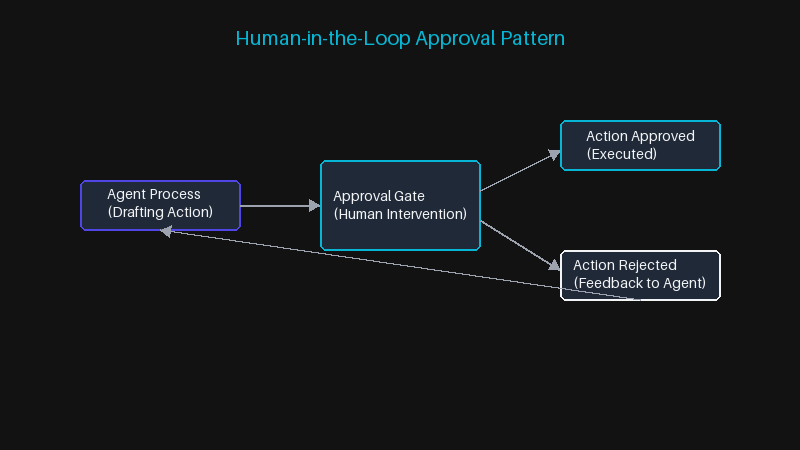 Human-in-the-loop Approval Pattern
Key Human Intervention Patterns
There are three common HITL configurations:
- Active Approval: The agent pauses execution before performing critical actions (e.g. running code or sending an email) and waits for a human to click "Approve" or "Reject".
- Review & Edit: The human reviews draft outputs (e.g., an email or code snippet) and can modify them before sending or execution.
- Feedback Loops: If the agent fails a task, the human can provide textual feedback to guide the agent's next attempt.
Designing a Human Gate State Machine
We can model the approval state mathematically using a finite state machine. Let S represent the workflow state:
S_{next} = \begin{cases}
S_{execute} & \text{if } A = \text{"approved"} \\
S_{edit} & \text{if } A = \text{"edit"} \\
S_{terminate} & \text{if } A = \text{"reject"}
\end{cases}
where A is the human action input.
Python Code: A Human Approval Loop in LangGraph
Here is how you can implement a human intervention check inside an agent execution flow:
class AgentWorkflow:
    def __init__(self):
        self.state = "drafting"
        self.draft = ""

    def draft_action(self, task):
        self.draft = f"Proposed email text for: {task}"
        self.state = "awaiting_approval"
        print(f"Agent Drafted: {self.draft}")
        print("Workflow paused. Awaiting human input...")

    def receive_human_decision(self, approved: bool, feedback: str = ""):
        if self.state != "awaiting_approval":
            raise ValueError("Workflow is not paused for approval.")

        if approved:
            self.state = "executing"
            self.execute_action()
        else:
            self.state = "revision"
            print(f"Revision needed. Feedback: {feedback}")
            # Loop back to drafting using feedback
            self.state = "drafting"

    def execute_action(self):
        print(f"Action executed: Sending '{self.draft}'")
        self.state = "complete"

# Run Workflow
wf = AgentWorkflow()
wf.draft_action("Welcome email to client")

# Human reviews and rejects with feedback -> agent returns to drafting
wf.receive_human_decision(approved=False, feedback="Make it more friendly.")

# Agent produces a revised draft, human approves -> action executes
wf.draft_action("Welcome email to client (friendlier tone)")
wf.receive_human_decision(approved=True)

print("Final state:", wf.state)  # complete
Implementing Human-in-the-Loop in Production
To build HITL workflows in production:
- Use persistent state stores so workflows can be paused indefinitely without losing progress.
- Implement webhooks or message queues (like RabbitMQ) to notify humans when tasks are waiting in the queue.
- Use libraries like LangGraph, which provide native support for pausing and resuming execution graphs.
Conclusion
The failure mode nobody designs for is approval fatigue. A gate only provides safety while the human behind it is actually reading. Put a reviewer in front of two hundred approvals a day where 198 are obviously fine, and within a week they are clicking approve on pattern recognition alone — the two that mattered sail through, and you now have a system that is less safe than one with no gate, because everyone downstream believes it was checked. If your approval rate is above roughly 95%, the gate has stopped doing work and started manufacturing false assurance.
The fix is to gate less, not more. Route on blast radius: let the agent act freely on reversible, low-cost operations and reserve human review for the actions that are expensive or impossible to undo. Sending an internal draft is reversible. Wiring money, dropping a table, and emailing a customer list are not. A system with three genuinely consequential approvals per day gets real scrutiny on all three.
Two design details matter more than they look. Give the reviewer enough context to actually judge — the proposed action, the reasoning that led to it, and what happens if it is wrong — because an approval dialog showing only a payload invites reflexive assent. And decide explicitly what happens on timeout. Workflows will sit unapproved over weekends and through vacations, and "wait indefinitely" is a real answer but so is escalation or automatic rejection; systems that never specify one tend to discover their default by accident, usually during an incident.
The uncomfortable trade-off underneath all of this is that HITL converts a throughput problem into a staffing problem. An agent that needs approval on every action runs at human speed and costs human wages, which for many use cases means the automation no longer pays for itself. That is sometimes the correct answer — some decisions should be slow. But it should be a decision you made deliberately, rather than the thing you discover three months in when the review queue has become someone's full-time job.