A Beginner's Guide to Retrieval-Augmented Generation (RAG)
 By Bishwambhar Sen
Large Language Models (LLMs) like ChatGPT and Claude are incredible at generating text, summarizing information, and writing code. However, they suffer from a fundamental limitation: their knowledge is frozen in time at the moment they were trained, and they don't have access to your private company data.
When asked about recent events or proprietary documents, LLMs are prone to hallucination—confidently making up plausible-sounding but entirely incorrect answers.
To solve this, AI engineers use a powerful architectural pattern known as Retrieval-Augmented Generation (RAG).
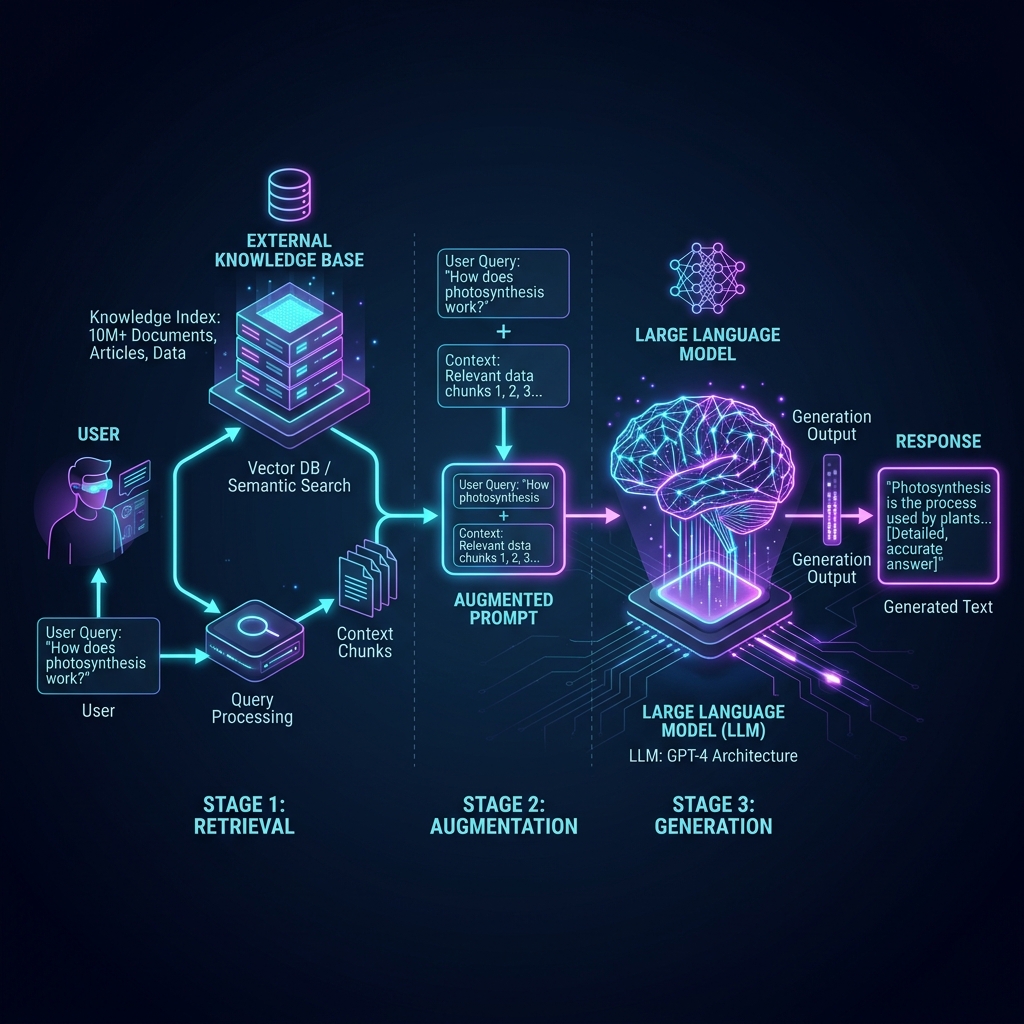 Retrieval-Augmented Generation (RAG) Architecture and Pipeline Flow
What is RAG?
Retrieval-Augmented Generation is exactly what it sounds like: it is the process of retrieving relevant information from an external database and passing it to a Generative AI model to augment its response.
Instead of asking the LLM a question and hoping it memorized the answer during training, RAG acts like an open-book exam. You give the LLM the exact documents it needs to read to answer the question accurately.
The RAG Architecture
A standard RAG pipeline consists of two main phases: Ingestion (preparing your data) and Generation (answering the user's query).
1. The Ingestion Phase
Before you can answer questions, you need to prepare your data.
- Document Loading: Extract text from your PDFs, Notion pages, databases, or websites.
- Chunking: Break the long documents into smaller, manageable pieces (chunks) of a few hundred words each. LLMs have context limits, so we cannot send them an entire library of books at once.
- Embedding: Pass each text chunk through an Embedding Model. This model converts the human-readable text into a dense vector (a long list of numbers) that represents the semantic meaning of the text.
- Vector Database: Store these vectors along with their original text in a specialized Vector Database (like Pinecone, Chroma, or Weaviate).
2. The Generation Phase
When a user asks a question, the pipeline springs into action in real-time.
- Embed the Query: The user's question is passed through the same Embedding Model to convert it into a vector.
- Semantic Search: The Vector Database compares the user's query vector against all the document chunk vectors. Because vectors representing similar concepts are mathematically close to each other, the database can instantly retrieve the top 3-5 most relevant chunks of text.
- Prompt Augmentation: The retrieved text chunks are injected into a prompt alongside the user's original question. The prompt looks something like this:
"You are a helpful assistant. Use the following context documents to answer the user's question. If the answer is not in the context, say 'I don't know'." Context: [Inserted Document Chunks] Question: [User's Question]
- Generation: The LLM reads the augmented prompt and generates a highly accurate, hallucination-free response based strictly on the provided context.
Why is RAG so powerful?
RAG has become the industry standard for enterprise AI applications for several critical reasons:
- Accuracy: It virtually eliminates hallucinations by forcing the model to cite its sources.
- Up-to-date Knowledge: You don't need to retrain a massive model when facts change. You just update the documents in your Vector Database.
- Data Privacy: The LLM never "memorizes" your private data. The data is kept secure in your database and only retrieved temporarily during the prompt.
- Cost Efficiency: Fine-tuning an LLM costs thousands of dollars and requires ML expertise. Setting up a RAG pipeline is inexpensive and can be done by standard software engineers.
Advanced RAG Techniques
As RAG pipelines mature in production, engineers implement advanced techniques to improve retrieval quality:
- Query Expansion: Using a smaller LLM to rewrite the user's query into multiple variations to cast a wider net during search.
- Re-ranking: Retrieving a large number of documents (e.g., top 20) and using a specialized Cross-Encoder model to re-score and sort them perfectly before sending them to the LLM.
- Hybrid Search: Combining traditional keyword search (BM25) with semantic vector search to get the best of both worlds.
One Correction Before You Build
This article said RAG "virtually eliminates hallucinations." That is the standard pitch, and it overstates things enough to be worth walking back.
RAG reduces one specific kind of hallucination: the model inventing facts it never had. It does not stop the model from misreading a document it was given, combining two chunks into a conclusion neither supports, or answering confidently when retrieval returned nothing useful. That last failure is the most common one in practice. Ask about something genuinely absent from your knowledge base and the vector search still returns its top five chunks — similarity search always returns something — and the model, handed five vaguely related paragraphs and a question, will usually produce an answer rather than declining. The "if the answer is not in the context, say I don't know" instruction helps, but it is a suggestion to a probabilistic system, not a guarantee.
There is a related trap in the claim about updating documents. Changing a source document only helps if you re-embed and re-index it. A pipeline that ingests once and never reconciles will happily serve last year's pricing forever, and it will do so with citations, which makes it more convincing than a plain hallucination rather than less. Deletion is worse: removing a file from the source folder does not remove its vectors. Plan the re-indexing story before you launch, not after someone reports the bug.
If you take one practical thing from this guide, make it this: your retrieval quality ceilings your entire system. No prompt engineering and no larger model can extract a correct answer from the wrong chunks. Before adding re-ranking, query expansion, or any of the advanced techniques listed above, write down twenty questions your users actually ask, run them through retrieval alone, and read the chunks that come back. If the right passage is not in there, that is the only problem worth working on.