GraphRAG: Knowledge Graphs for Enhanced Retrieval-Augmented Generation
 By Bishwambhar Sen
Retrieval-Augmented Generation (RAG) typically uses vector databases to locate text chunks based on semantic similarity. While vector databases are highly efficient for local query-matching, they struggle with global reasoning tasks, such as summarizing themes across an entire document set or answering questions that require multiple logical connections ("multi-hop reasoning").
GraphRAG solves these limitations by combining structured Knowledge Graphs with standard RAG pipelines.
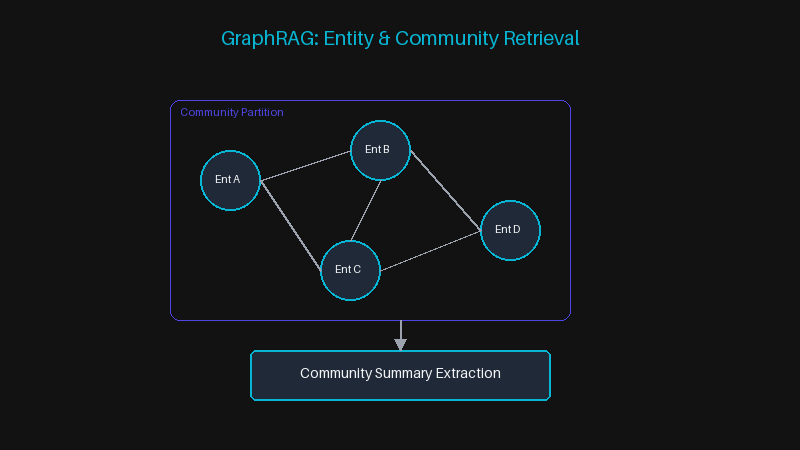 GraphRAG: Entity & Community Retrieval
The Architecture of GraphRAG
GraphRAG structures unstructured text by transforming it into a semantic network:
- Entity-Relation Extraction: An LLM scans text documents to extract entities (e.g., people, organizations, concepts) and their relationships.
- Knowledge Graph Construction: These entities and relationships are structured as nodes and edges. The graph representation is represented as:
G = (V, E)
where V is the set of entity vertices and E is the set of relationship edges.
3. Community Detection: Graph clustering algorithms (e.g., Leiden or Louvain) partition the graph into hierarchical clusters of related entities.
4. Community Summarization: The LLM writes summaries for each community cluster, creating pre-computed abstract representations of different sectors of the corpus.
Local Search vs. Global Search in GraphRAG
GraphRAG supports two main search configurations:
- Local Search: Used for queries regarding specific entities. The system finds vector-matched entities and traverses adjacent edges to retrieve related entities, relationships, and source text.
- Global Search: Used for queries regarding aggregate themes. The system retrieves pre-computed summaries across all community partitions at a specified hierarchical level and synthesizes a global response.
Python Code for Simple Graph Construction
Here is an example using NetworkX to structure a basic knowledge graph extracted from text:
import networkx as nx

# Create a graph
G = nx.Graph()

# Add nodes with attributes
G.add_node("RAG", type="concept", description="Retrieval-Augmented Generation")
G.add_node("GraphRAG", type="framework", description="Graph-based RAG")
G.add_node("Knowledge Graph", type="data_structure", description="Structured node-edge network")

# Add edges with attributes
G.add_edge("GraphRAG", "RAG", relation="extends")
G.add_edge("GraphRAG", "Knowledge Graph", relation="integrates")

# Query the graph
print("Entities connected to GraphRAG:")
for neighbor in G.neighbors("GraphRAG"):
    print(f"- {neighbor} via relationship: {G['GraphRAG'][neighbor]['relation']}")
The Benefits of GraphRAG
- Multi-Hop Reasoning: By traversing edges, the model can connect disparate facts that are located in separate sections of a corpus.
- Improved Context Integrity: By using community summaries, GraphRAG avoids missing context that might otherwise be split across vector chunk boundaries.
- Structured Traceability: Answers are directly traceable to specific paths in the knowledge graph, making evaluation and auditing easier.
Conclusion
Before you build this, look hard at the indexing bill. Constructing the graph means an LLM pass over every chunk to extract entities and relations, then another set of calls to summarize every community at every hierarchical level. Microsoft's own reporting put indexing a modest corpus in the tens of dollars, and cost scales with corpus size rather than with query volume — so a large document set can run into the hundreds or thousands before you have answered a single question. Vector indexing of the same corpus costs cents.
Worse, that cost is not one-time. Documents change. Adding a new document can create entities that should have merged with existing ones, alter the community structure, and invalidate summaries several levels up. Incremental update support has improved but remains the weakest part of every GraphRAG implementation, and plenty of teams end up simply re-indexing on a schedule. If your corpus changes daily, price that in as a recurring line item, not a setup cost.
Extraction quality is the other risk, and it compounds quietly. The LLM will emit "Acme Corp", "Acme Corporation", and "Acme" as three separate nodes unless you do entity resolution, at which point your graph fragments and multi-hop traversal breaks in ways that are hard to see from the outside — you get a plausible answer built on half the relevant subgraph. Budget real effort for entity normalization; it is not an afterthought.
The clean decision rule is about the shape of your questions. If users ask lookup questions — "what does the refund policy say," "which version fixed this bug" — the answer sits in one or two chunks and vector search finds it, with GraphRAG adding cost and latency for nothing. GraphRAG earns its keep on corpus-level synthesis ("what themes recur across these 400 incident reports") and on genuine multi-hop chains where no single chunk contains the answer. Those are real needs, but they are a minority of queries in most products. A reasonable path is to ship vector RAG, log the questions it fails, and only reach for a graph if the failures cluster in that second category.
Go deeper in the course
- Generative AI & LLMsLesson 4: RAG (Retrieval-Augmented Generation) BasicsConnect an LLM to external documents using vector embeddings.
- Embeddings & Vector DatabasesLesson 4: Vector Database FundamentalsLearn what a vector database is, how it differs from a relational database, and get hands-on with ChromaDB — the most learner-friendly vector store.